
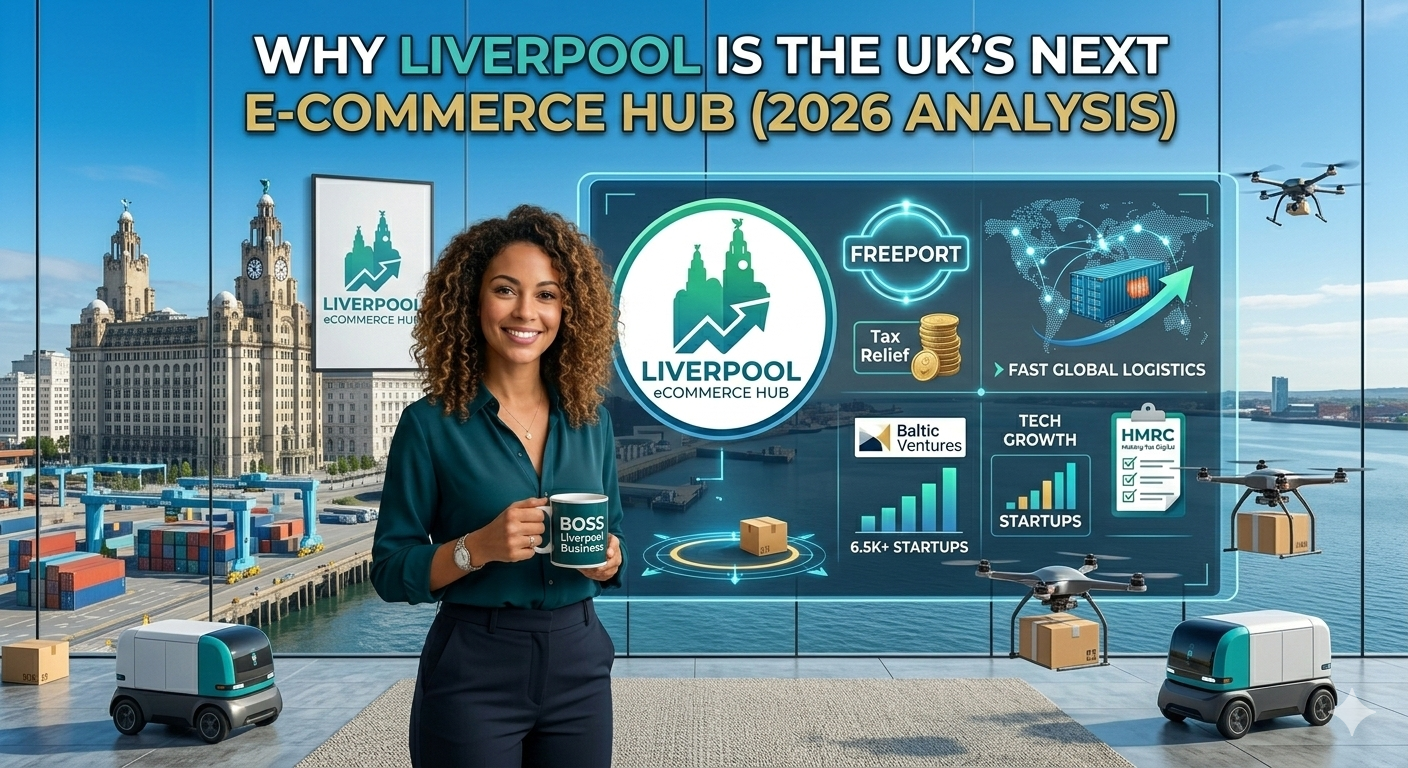
For decades, the mention of Liverpool and “shipping” conjured images of heavy industry and the historic docks. But as we move through 2026, a new kind of cargo is defining the Mersey: Digital Trade. While London has the capital and Manchester has the “MediaCity” tag, Liverpool has quietly transformed into the UK’s most strategic e-commerce powerhouse. From the high-tech warehouses of Speke to the digital accelerators in the Baltic Triangle, the city is no longer just “participating” in the digital economy—it’s leading it.
Here is why Liverpool is officially the UK’s next e-commerce hub.
1. The “Freeport” Factor: A Tax-Free Gateway
The single biggest catalyst for Liverpool’s e-commerce explosion has been the Liverpool City Region Freeport.
Unlike a standard port, the Freeport allows e-commerce businesses to import components or stock, store them, and even “add value” (like re-packaging or assembly) without paying UK customs duties or VAT until the goods enter the domestic market.
- Cash Flow Advantage: For a Shopify startup importing from the US or Asia, this is a game-changer. You don’t pay the tax upfront, keeping more cash in your business for marketing and scaling.
- Duty Inversion: If you import parts and build a finished product inside the Freeport, you often pay a lower tariff on the final item than you would on the individual parts.
2. Port-Centric Logistics: From Ship to Door in Hours
In e-commerce, speed is the only currency that matters. Liverpool’s geography gives it a “unfair advantage.”
- Catchment Area: Over 35 million people live within a 150-mile radius of the Port of Liverpool. By landing goods here rather than in southern ports like Felixstowe, sellers can bypass the congested M6/M25 corridor.
- Port-to-Parcel: Peel Ports has pioneered “on-port” warehousing. In 2026, we are seeing e-commerce hubs processing 40,000 daily parcels directly from the dockside. This eliminates an entire leg of the supply chain, reducing shipping costs by up to 18%.
3. The Baltic Triangle: The Silicon Valley of the North
While the heavy lifting happens at the docks, the “brains” of the operation are in the Baltic Triangle. This once-derelict warehouse district is now home to over 6,500 digital and tech businesses.
- Tech Accelerators: Programs like Baltic Ventures are funneling millions into early-stage e-commerce tech startups.
- The Talent Pipeline: With three major universities (University of Liverpool, LJMU, and Hope), the city is churning out graduates who are “digital natives.” Liverpool now has one of the highest concentrations of Shopify developers and e-commerce marketing specialists in the UK.
4. The “Very” Big Players
Success breeds success. Liverpool is already the home of The Very Group (Very.co.uk and Littlewoods), a multibillion-pound pioneer in “AI-driven retail.” Having a titan like Very headquartered in Speke has created an ecosystem of satellite businesses. If you are a logistics firm, a packaging supplier, or a fintech developer, you want to be where the big players are. This “clustering” effect is what turned Seattle into a tech hub, and it’s doing the same for Liverpool in the e-commerce sector.
5. Innovation Capital of 2026
In late 2025, Liverpool was shortlisted as a finalist for the European Capital of Innovation. This wasn’t just for show; it reflected the city’s commitment to “Trade Tech.”
- Digital Trade Corridors: Companies like LogChain have recently relocated their HQs to Liverpool to build the digital infrastructure that makes international shipping paperless.
- Making Tax Digital (MTD): Local fintech startups are leading the way in helping small Shopify sellers automate their HMRC filings, making Liverpool the easiest place in the UK to stay tax-compliant.
6. The “Scouse Brand” Appeal
There is a cultural element to Liverpool’s e-commerce rise that data can’t fully capture: The Global Scouse Brand. Liverpool is a globally recognized city. Whether it’s through football (LFC/EFC) or music, the “Liverpool” name carries weight in markets like the USA, Scandinavia, and Asia.
- Local entrepreneurs are leveraging this “geographic brand equity” to sell everything from Liverpool-themed streetwear to artisan gin.
- The “Born in Liverpool” badge on a Shopify site acts as an instant trust signal for international buyers.
7. Connectivity & Infrastructure
The Liverpool City Region has invested over £500 million into an integrated transport and digital network.
- Project Violet & Sci-Tech Daresbury: High-speed fiber and AI research facilities are providing the backbone for e-commerce data processing.
- Merseyrail Expansion: New stations like the Baltic Station (opening 2026) make it easier for tech talent to commute into the city’s creative heart.
The Verdict: Why Now?
In 2026, the cost of doing business in London has become prohibitive for many startups. Liverpool offers a unique cocktail of low operating costs, Freeport tax breaks, and world-class shipping infrastructure.
If you are starting a Shopify store today, you aren’t just looking for a website; you are looking for a supply chain. Liverpool is the only city in the UK that offers a 360-degree solution: you can import the goods, store them tax-free, hire the developers to build the site, and use a local parcel network to deliver them—all within an L-postcode.
Liverpool isn’t just the UK’s next e-commerce hub. It’s the new standard.